
Overview
LEAF is a language-aligned EEG foundation model. It first learns EEG structure without labels, then aligns EEG representations with natural-language task descriptions and label prototypes. The aligned model can make predictions by comparing an EEG embedding with frozen text embeddings instead of using a separate classifier head for every task.
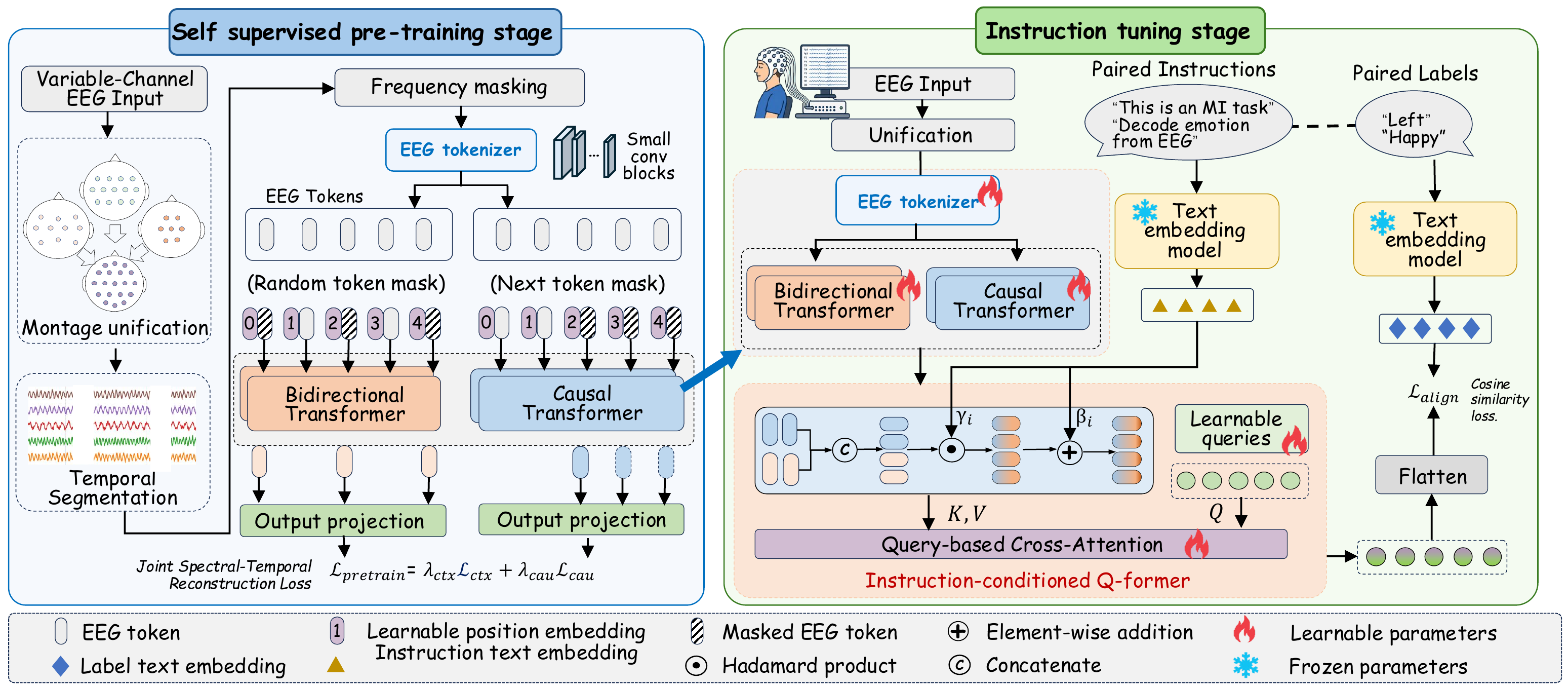
End-to-end workflow
- Prepare each downstream dataset. Dataset-specific scripts read the original files, filter and resample the signals, divide recordings into trials, and write HDF5 files.
- Normalize the electrode space. The shared preprocessing pipeline clips extreme values, applies robust scaling, maps channel names to the 65-channel LEAF montage, and interpolates missing template channels.
- Prepare the pretraining corpus. Pretraining expects one or more
.npyarrays containing trials shaped(trials, 65, time). - Pretrain the EEG Tower. Spectral perturbation is applied to the input. A bidirectional masked branch and a causal next-window branch reconstruct the original waveform.
- Cache language embeddings. All target labels and instruction strings are encoded by the selected text model and stored in
text_embeddings/. - Instruction-tune LEAF. The pretrained Tower and Instruction-conditioned Q-Former are trained jointly. The output EEG embedding is classified against frozen text prototypes using cross-entropy.
- Evaluate or fine-tune. Direct inference compares EEG and text embeddings without additional training. Supervised fine-tuning adapts either the EEG encoder with a new MLP head or the existing encoder and Q-Former with fixed text prototypes to one selected dataset.
Main entry points
| Stage | Entry point | Main input | Main output |
|---|---|---|---|
| Text cache | init_text_embeddings.py |
configs/tasks.yaml, text encoder |
text_embeddings/<model>.txt/.npy |
| Pretraining | a_pretrain.py |
Pretraining .npy files |
epoch-5/10 Tower checkpoints, leaf-pretrain-loss.npy |
| Instruction tuning | b_instruct_tuning.py |
Downstream HDF5 files, text cache | periodic itNNN.ckpt, loss_it.npy |
| Direct evaluation | c_direct_inference.py |
tuned checkpoint, test splits | combined per-dataset CSV and run metadata |
| Encoder + MLP fine-tuning | d_downstream_add_mlp.py |
instruction-tuned checkpoint, one dataset | validation-selected checkpoint and test metrics |
| Q-Former + cosine CE fine-tuning | d_downstream_qformer_ce.py |
instruction-tuned checkpoint, one dataset, text cache | validation-selected checkpoint, fixed text readout, and test metrics |
| Held-out evaluation | zero_shot_heldout.py |
Dreyer2023 and Weibo2014 HDF5 | combined zero-shot CSV |
| Embedding export | export_leaf_embeddings.py |
tuned checkpoint, test splits | per-dataset .npz embeddings and summary CSV |
Current dataset scope
The paper reports 16 datasets: eight motor-imagery datasets, five emotion datasets, one SSVEP dataset, one covert-speech dataset, and one workload dataset. See the dataset index for the exact labels and split rules.
Important distinction
The downstream HDF5 files and the pretraining .npy corpus are separate products:
paths.downstreamcontains labeled HDF5 datasets used by instruction tuning, inference, and downstream fine-tuning.paths.pretraincontains unlabeled.npytrial arrays used only bya_pretrain.py.
Architecture
The default input convention is 65 channels at 200 Hz, with a maximum instruction-tuning length of 2,000 samples. The tokenizer divides EEG into non-overlapping 100-sample windows and applies a temporal convolution, a spatial convolution across all channels, synchronized batch normalization, GELU, pooling, and dropout.
The Spectral-Temporal Reconstruction Tower has two independent 12-layer Transformer branches sharing the tokenizer and positional embedding:
- a bidirectional branch masks 50% of window tokens and reconstructs the original waveform;
- a causal branch uses corrupted windows through position
ito predict the clean waveform in the next window,i+1.
A random 6 Hz band with a lower edge sampled from 1-50 Hz is removed before both reconstruction losses. At inference, the two branch outputs are concatenated, producing 40 tokens for a 10-second trial or 16 tokens for a 4-second trial.
The Instruction-conditioned Q-Former uses eight learned 256-dimensional queries and four layers. The text instruction modulates Tower tokens through FiLM, after which queries cross-attend to the tokens. Flattened query outputs are projected into the selected text space and L2-normalized. Classification uses cosine-similarity logits against frozen normalized label embeddings.
Default model dimensions
| Parameter | Value |
|---|---|
| Sampling rate / channels | 200 Hz / 65 |
| Maximum length | 2,000 samples |
| Window length | 100 samples |
| CNN width / token dimension | 64 / 256 |
| Tower layers per branch | 12 |
| Attention heads / FF expansion | 8 / 4x |
| Transformer dropout | 0.1 |
| Q-Former queries / layers | 8 / 4 |
Configuration files
| File | Purpose |
|---|---|
configs/LEAF_mpnet.yaml |
Model plus pretraining, instruction-tuning, and downstream defaults using MPNet |
configs/LEAF_qwen3-4b.yaml |
Same defaults using Qwen3-4B text embeddings |
configs/env.yaml |
Raw, pretraining, and downstream data roots plus text-encoder registry |
configs/tasks.yaml |
Ordered labels and instruction pools |
configs/LEAF-ch65/ |
Electrode aliases, montage coordinates, and reference PDF |
The model YAMLs currently differ only in text_emb_model_name. --dim can override architecture using window-cnn-token-tower_layers[-queries-qformer_layers]; the default full value is 100-64-256-12-8-4. --emb overrides the configured text encoder.
Label order in configs/tasks.yaml must exactly match integer labels stored in HDF5. Changing any label or instruction requires updating the corresponding text cache.
Default configuration/task/environment paths are anchored to load_config.py, but CLI defaults and ckpt/ outputs are generally relative to the working directory. Run commands from the repository root.